Groom Biodata Format — What to Include
A complete guide to the groom biodata format for marriage. Every section explained — what families look for, what to write, and how to present it with confidence.
Key sections in a groom’s biodata:
- ✓Professional Photo
- ✓Detailed Education (Degree, College)
- ✓Career & Income (Company, Role, CTC)
- ✓Structured Family Details
❌ Most families still send:
✨ There is a simpler way:
Open instantly on any phone with full resolution photos, horoscope, and details in one place.
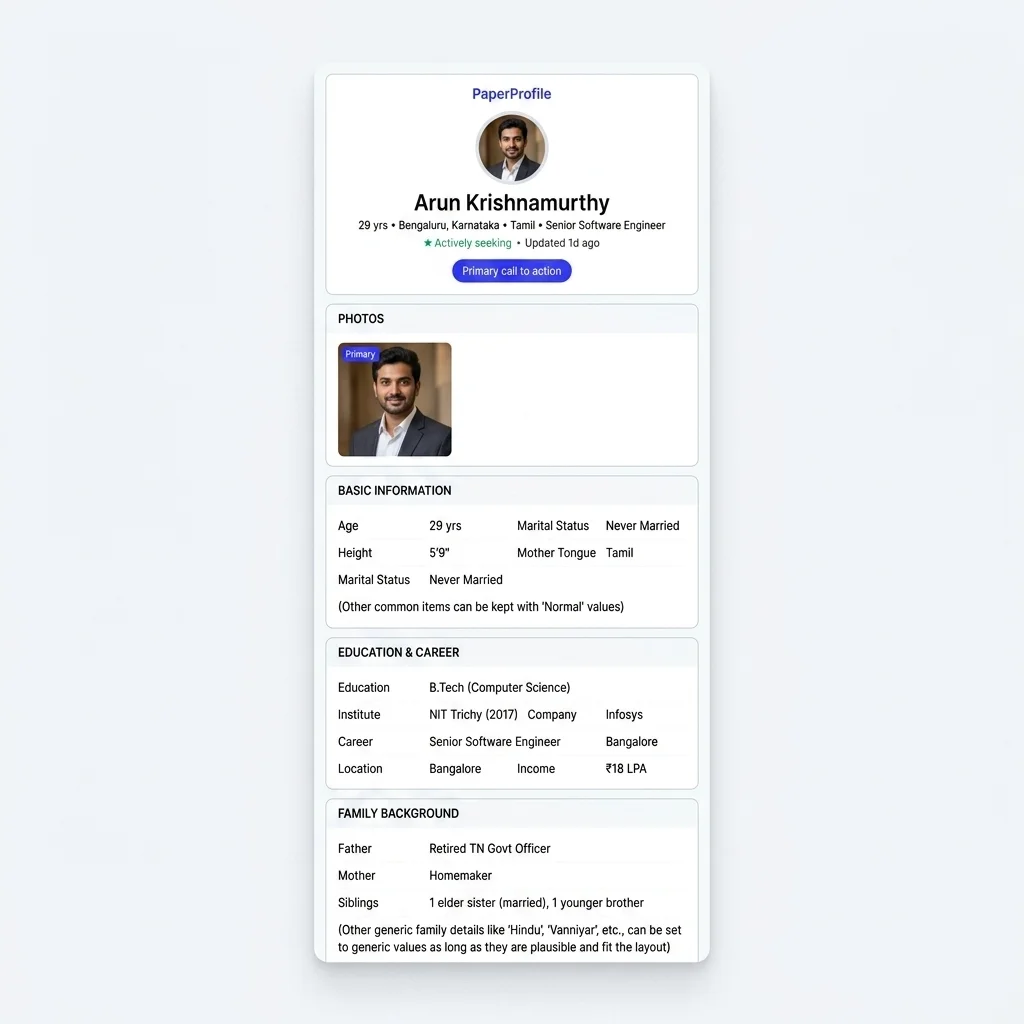
Modern groom biodata structures prioritize career stability, education credentials, family background, and photo quality.
TL;DR — Key Takeaways
- ✓A recent, clear portrait photo is the first thing families look for.
- ✓List name, age, height, location, caste, and mother tongue in personal details.
- ✓Specify precise degrees and colleges (e.g. B.Tech CS, NIT Trichy; MBA, IIM Kozhikode).
- ✓State company name, role, and current work location clearly. Income transparency is a positive signal.
- ✓Include sibling occupations and marital status as families look for these details early.
- ✓Keep your contact details private by default on the public profile.
A groom biodata for marriage is the primary document families use when evaluating a match. Most families decide within 60 seconds whether to read further or move on. Getting the format and content right means more responses, faster decisions, and the right conversations starting sooner.
The format for a groom biodata has evolved. The old one-size-fits-all Word document template does not reflect how families share and review biodata today. It is critical to structure your details in a readable, professional format that highlights education, career stability, and family background. For general structuring rules, consult the Best Biodata Format for Marriage guide.
Anatomy of a Perfect Groom Biodata
Families scanning a groom’s biodata do not read word-for-word initially. They scan. If details are unorganised or key details are missing, the profile gets skipped. A perfect groom biodata format aligns sections in a strict scanning hierarchy: Photo ➔ Personal Details ➔ Education ➔ Career & Income ➔ Family ➔ Expectations ➔ Horoscope. You can see how this structure looks in practice by looking at our Marriage Biodata Examples.
1. Photo: The First Impression
A clear, recent photograph is the single most important element of a groom’s biodata. Matrimonial profiles without photos receive up to 80% fewer responses. Avoid casual selfies, heavy social media filters, cropped group photos, or low-resolution scans.
Key Insight
✅ Best practice: Use a recent (within last 6 months) portrait taken in natural, soft light. Traditional or formal clothing works best. Choose a clean, neutral background that doesn’t distract from your face.
2. Personal Details: The Fast-Scan Fields
This section sits directly below the photo and houses the absolute essentials. Keep them structured in clean lines rather than paragraphs. Do not make families hunt for basic details.
- Full Name: Professional presentation, preferably with native family naming convention.
- Date & Time of Birth: Age is processed immediately; birth time helps early horoscope checking.
- Height: Checked early for compatibility matching.
- Religion, Caste, Sub-Caste: Essential community markers for family compatibility.
- Mother Tongue: Defines regional background and cultural fit.
- Current City: Specifies current residence, which is critical for career alignment.
- Marital Status: Clear mention of "Never Married", "Divorced", or "Widower".
Still sharing your biodata the old way?
Create a secure PaperProfile link. Keep your contact details private and update anytime.
3. Education: Specificity Builds Trust
Specify the highest qualification, the institution, and the year of completion. If you have multiple degrees, list them in reverse chronological order. Specificity here builds early trust.
"Graduate in Engineering, done from a college in South India."”
Key Insight
✅ Specific & clear: "B.Tech in Computer Science from NIT Trichy (2017). MBA in Finance from IIM Kozhikode (2019)."
4. Career & Income: Present Stability
State your current employer (or business type), your role, and your work location. Income is optional but increasingly expected by families in urban markets to ensure early alignment.
"Working in IT company in Bangalore, earning well."”
Key Insight
✅ Specific & clear: "Senior Software Engineer at Infosys, Bangalore. Current role is product-focused. Annual CTC: ₹18 LPA."
If you are self-employed or run a business, specify the nature of the business, years of operation, and scale (e.g. "Managing Partner, Family Textile Retail Business established in 1994, Bangalore").
5. Family Background: Native and Sibling Details
In the Indian arranged marriage context, families evaluate family compatibility closely. The family notes section should give a complete view of parents, siblings, and ancestral roots.
- Father's Name & Profession: Detail the specific business or job role (e.g. "Father: Retired TN Govt Officer" rather than just "Retired").
- Mother's Name & Profession: Detail whether working or homemaker.
- Siblings: List brothers and sisters with their education, current role, and marital status (e.g. "1 elder sister (married, settled in Coimbatore), 1 younger brother (pursuing CA)").
- Native & Ancestral Place: Essential for traditional compatibility checks.
- Family Values: Describe values (e.g., traditional, modern, close-knit) without using long paragraphs.
6. Expectations: Keep it Welcoming
Your partner preference section should be honest but welcoming. Keep it to 3–4 concise sentences covering preferred age range, educational background, location alignment, and career support. Avoid presenting a long list of rigid demands, which can discourage genuine families from starting a conversation.
7. Horoscope Details
For families who check astrology matching, providing horoscope details up front saves weeks of delayed back-and-forth. Include Rasi, Nakshatra, Lagnam, and Dosham. If horoscope matching is not checked by your family, state "Horoscope matching is not required" or "Horoscope details available on request."
Still sharing your biodata the old way?
Create a secure PaperProfile link. Keep your contact details private and update anytime.
Common Groom Matrimonial Mistakes (And How to Avoid Them)
Our study of profile sharing shows that simple mistakes can lead to instant skips. The table below covers the most common errors.
| Mistake | Why it hurts |
|---|---|
| ❌ No Photo Attached | Matrimonial profiles without a clear photo are skipped instantly by up to 80% of families. |
| ❌ Hiding Income Range | Creates a lack of transparency and delays alignment in urban/professional setups. |
| ❌ Skipping Sibling Occupations | Makes the family background look incomplete or non-transparent to traditional evaluators. |
| ❌ Demanding Expectation List | Appears rigid, inflexible, and unapproachable, deterring good prospects from reaching out. |
Traditional Biodata vs Private Digital Link
Once you send a static biodata file over WhatsApp, it is permanent — you lose control over who forwards it, who stores it, and who views your contact information. If you need to make changes to your income, job, or location, you have to resend a new file to everyone. For a complete analysis, read our guide on Why PDFs Are Bad for Marriage Biodata.
A digital marriage profile (like PaperProfile) solves this by hosting details under a private link. You retain full custody of your data: you can hide contact details and delete the profile at any time when a match is finalized. To understand this technology, see What is Digital Biodata. To build your own, check out our guide on How to Create a Marriage Profile, and learn how to share it on WhatsApp by reading How to Send Marriage Biodata on WhatsApp.
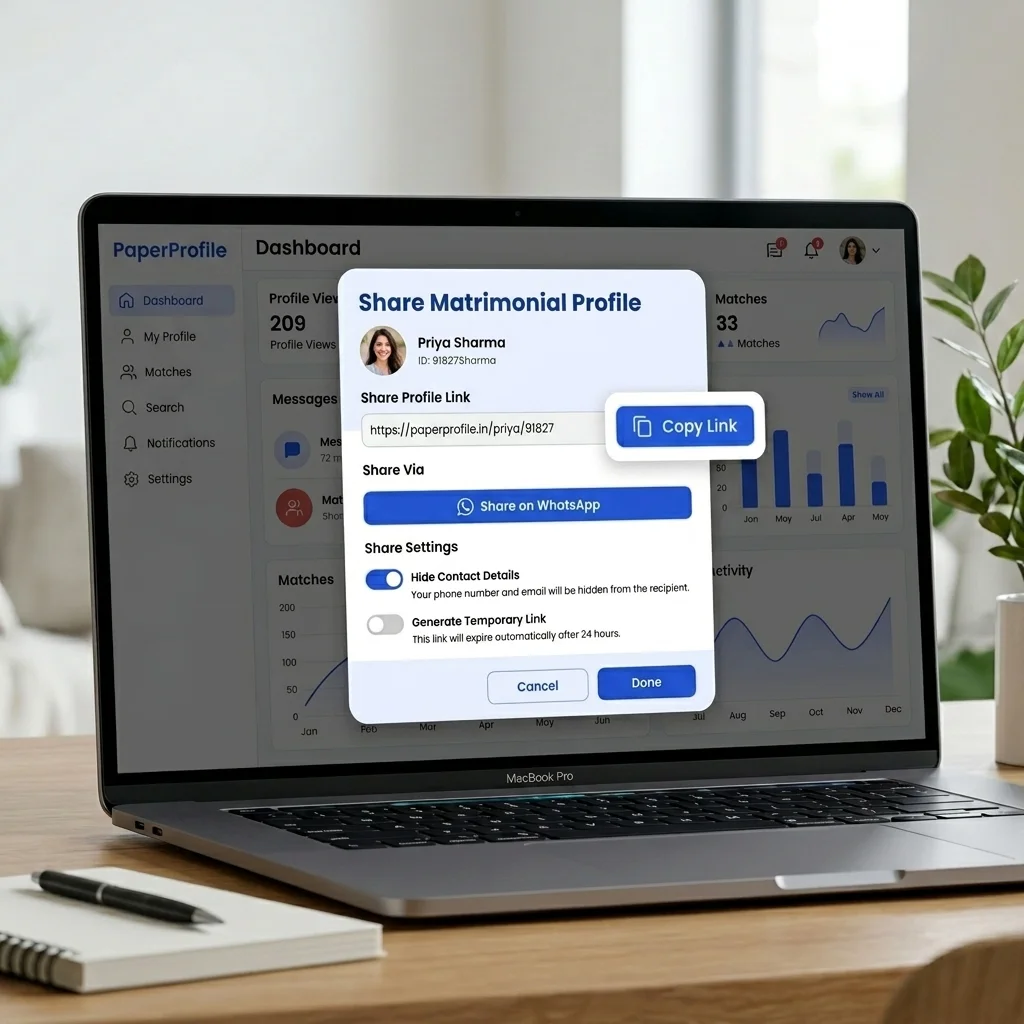
Matrimonial Biodata Checklist for Grooms
Ensure your profile matches this complete checklist before sending it to prospective families:
- ✅ Recent, professional portrait: Well-lit, high resolution, plain background.
- ✅ Personal details: Name, age, height, current city, religion, caste, mother tongue.
- ✅ Clear education: Specific degree, major, university name, and graduation year.
- ✅ Explicit career status: Job role, employer name/industry type, work location, and career plans.
- ✅ Structured family notes: Parent professions, brother/sister details (occupations & marital status), and native place.
- ✅ Horoscope info: Nakshatra, Rasi, Lagnam, and Dosham (explicitly state "none" if not applicable).
- ✅ Privacy settings: Contact details hidden by default from the public profile.
Written By
PaperProfile Team
We study how Indian families share marriage profiles, biodata, photos, and horoscope information on WhatsApp.
PaperProfile helps Indian families create secure, private marriage profiles and share them as single links on WhatsApp. We eliminate version confusion, attachments size issues, and forwarded PDF files.
Frequently Asked Questions
Should a groom include annual CTC?+
Including an annual CTC range (e.g. ₹18–22 LPA) is increasingly expected in urban settings to ensure early alignment, but you can choose to make it private.
How should self-employed grooms state their occupation?+
Describe the sector (e.g. "Managing Partner, Family Textile Retail Business") and include details like years established or office location to demonstrate stability.
How can I protect my privacy when sending my biodata?+
Instead of sharing a static biodata file on WhatsApp, share your profile as a secure PaperProfile link. This allows you to hide your phone number and delete the profile whenever you wish.
📖 Suggested Reading
Best Biodata Format for Marriage — Section Order, Content, and What Families Actually Read
The right section order is only half the problem. Most biodata fail because the content is too generic. This guide covers exactly what to write in each section — with real examples.
Bride Biodata Format — What to Include
A complete guide to the bride biodata format for marriage. Every section explained — what families look for, what to write, and how to present it with confidence.
Marriage Biodata Example for Indian Families
A real marriage biodata example with all sections filled in — for both groom and bride. Use it as a reference when creating your own.
Create a professional groom profile in 5 minutes
Stop forwarding your biodata, raw photos, and horoscope details on WhatsApp. Share one private link instead.
No credit card required. Free to start.